The first time I taught East of Eden, half my class didn’t know it was about Cain and Abel. Same thing the next year with Beowulf — of Cain’s clan sailed right past them. Then a student asked me why a Pixar movie about a robot cleaning Earth had a dove with an olive branch in it. I realized something obvious: my students were reading entire layers of literature past them because they didn’t know the ground floor.
The ground floor is Genesis 1–11.
Eleven short chapters. Creation, the Garden, Cain and Abel, Noah’s flood, the Tower of Babel. Three thousand years of literary afterlives. And in most public-school ELA classrooms, completely absent — not because it’s not literature, but because teachers worry about the church-state line. The truth is, the Supreme Court explicitly affirmed Bible-as-literature instruction in Abington v. Schempp (1963). It’s defensible, it’s teachable, and it makes every novel after it land harder. Here’s how I teach it.
1. Frame It as World Literature, Not Theology
The first sentence I say to students: “We’re going to read Genesis the way we’d read The Odyssey.” That framing changes everything. We’re not asking whether the stories are true. We’re asking what they do — as narrative, as archetype, as cultural inheritance. The tone is academic. The questions are literary. What does the text refuse to explain? Why might the narrator have made that choice? What other stories in world literature work this same way?
Pair Genesis 1–11 explicitly with Gilgamesh’s flood narrative and the Egyptian creation myths. Show students the parallels and the differences. The point isn’t to argue that Genesis is better — it’s to show them they’re reading a text in conversation with a much older literary tradition. That move alone settles 90% of the worry about the church-state line. You’re not catechizing. You’re doing comparative literature.
2. Teach the Literary Techniques Explicitly
Genesis 1–11 is doing things on purpose, and once students see what, they can’t unsee it. Five techniques worth naming directly:
Chiasm — the literary structure where the second half mirrors the first in reverse. The flood narrative is built on a giant chiasm, with “God remembered Noah” at the structural center. The story’s pivot isn’t the destruction — it’s the act of memory. Students who learn this read better for the rest of their lives.
Etymological wordplay. Adam (adam) plays on the Hebrew for ground (adamah). Eve (chavvah) sounds like “living” (chai). Babel sounds like the Hebrew for “confuse” (balal). These names are clues, not labels. Teaching this teaches students to ask what every name in literature might be doing.
Doublings. Two creation accounts side by side. Two flood traditions woven together. These aren’t bugs — they’re features that let the text hold contradictions in tension. Useful framing for any novel that complicates a simple narrative.
Archetype. The fall, the flood, the brother who kills his brother. Once students see these as foundational patterns, they recognize them everywhere — Beowulf, The Tree of Life, Wall-E.
Refusal to explain. Why did God prefer Abel’s offering? The text never says. Genesis is full of these gaps, and they invite the reader into the story. The silences are part of the design — and a perfect entry point into how literature works.
3. Use the Stories Reluctant Readers Will Actually Engage With
Here’s the thing about Genesis 1–11: the stories are good. Cain killing Abel because his offering was rejected is a real moral puzzle. Noah getting drunk and naked in his tent after the flood is genuinely uncomfortable. The Tower of Babel as a parable about empire and pride still hits in 2026. These aren’t sanitized morality tales. They’re literature with edges.
For inclusion classrooms and reluctant readers, the trick is leveled passages — give students one self-contained reading per session, not eleven chapters at once. Build in comprehension checks that scaffold into the harder analysis. Use open-response prompts that are invitational rather than evaluative (“If you were God, would you have killed Cain? Why or why not?”). Students who would shut down on a literary-analysis essay will produce real thinking when invited to take a position.
4. Make the Cultural Afterlives Explicit
The single most powerful move in this unit is the cultural afterlives spread. Show students explicitly: East of Eden is named for Cain’s exile. Beowulf calls Grendel “of Cain’s clan.” Wall-E is a flood narrative — a single righteous survivor saving the seeds of life. Paradise Lost retells Genesis 3 in ten thousand lines. “Am I my brother’s keeper?” has been quoted by every U.S. president from Lincoln to Obama. “By the sweat of your brow.” “Forbidden fruit.” “From dust to dust.” The English language is laced with Genesis, and once students see it, every novel they read after lands harder.
This is also where the unit pays for itself. Students walk out with the kind of cultural literacy that makes them better readers for the rest of their lives — which is what we’re really trying to teach.
5. Address the Common Misconceptions Directly
The forbidden fruit was never named in the text — the apple tradition comes from a Latin pun and medieval art. Eve was made from Adam’s “side” (Hebrew tsela), not strictly his rib. The serpent in the garden is never identified with Satan in Genesis itself; that identification develops centuries later. The mark of Cain is divine protection, not punishment. Genesis was written and edited over centuries from multiple sources.
Teaching the gap between what students remember and what the text actually says is one of the most powerful moves in the unit. It models close reading. It models intellectual humility. And it gives students the language to push back when someone misuses these stories — which they will, for the rest of their lives.
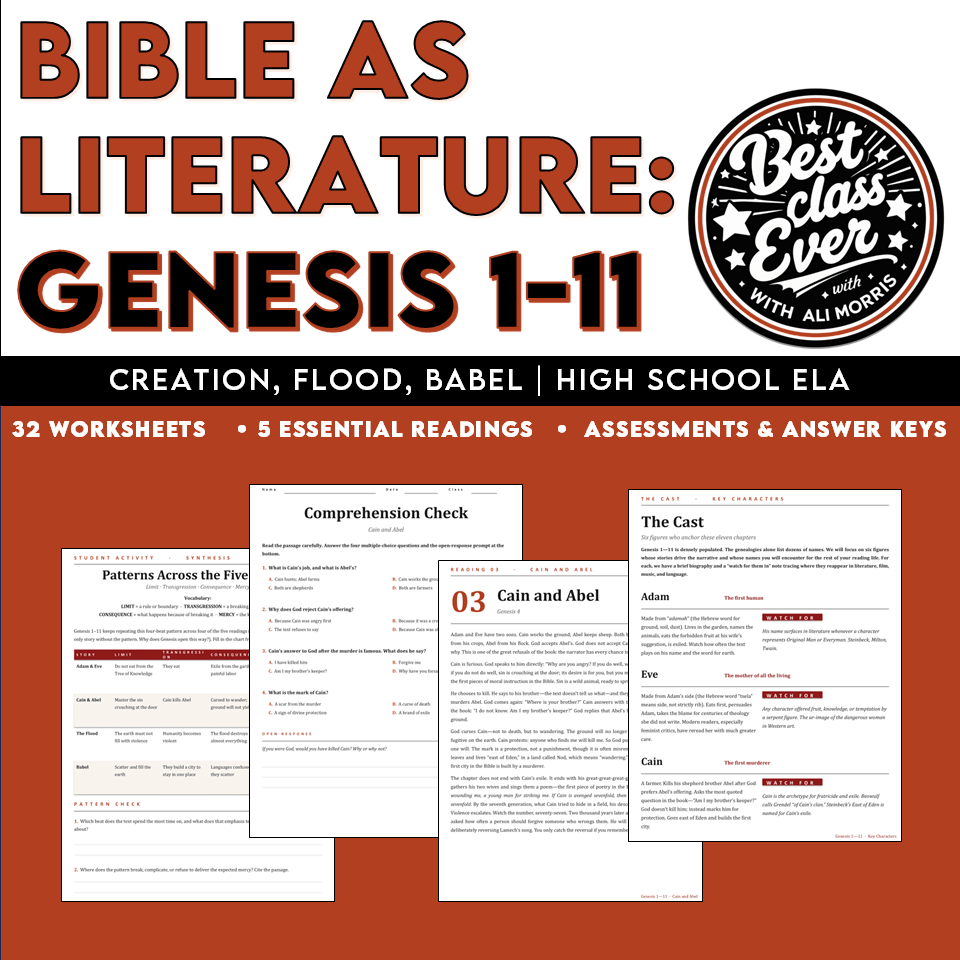
I built a unit around all of this — five reading passages, ten comprehension checks, the literary lens spread, the cultural afterlives, the misconceptions, an eighteen-question review with teacher answer key. Print-ready, magazine-style, designed for special-ed and inclusion classrooms while preserving the literary force of the original. Find it on TpT here. Two weeks of instruction, zero prep, real cultural-literacy payoff.
These are the stories your students will encounter for the rest of their reading lives. Make sure they read the originals first.


Leave a comment